
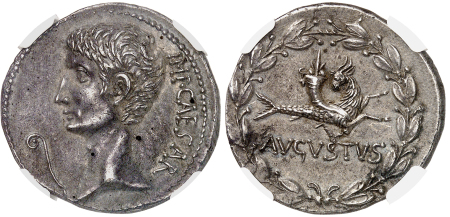
Lot 42 – Auguste (27-14)
Cistophore en argent -Pergame ou Ephèse ? (27-26)
D’une qualité exceptionnelle – Magnifique patinemédaillier.
Probablement le plus bel exemplaire connu, du meilleurstyle.
Exemplaire de la collection de Hans von Aulock (1906-1980),et de la vente Triton XI du 8 janvier 2008, N° 675 et de la vente Palombo 19 du12 décembre 2020, N°84.
Cet exemplaire publié dans : Sylloge Nummorum Graecorum.Deutschland. Sammlung von Aulock, vol. III, Berlin 1964, N° 6571, et dans A.Banti et L. Simonetti, Corpus Nummorum Romanorum, Florence 1979, vol. IV, N°280.Seulement 6 exemplaires connus des auteurs du RomanProvincial Coinage.
11.28g – RPC I 2205 – BMC manque – RIC 489 – CNR 280 (cetexemplaire) – SNG von Aulock 6571 (cet exemplaire)
Superbe à FDC – NGC Choice AU* (5/5 et 5/5)
The Res Gestae Divi Augusti (‘the achievements of the deified Augustus’), inscribed on two columns near his Mausoleum in Rome, the text of which has survived as an inscription in the Temple of Roma and Augustus in Ancyra (Ankara), tells us that he was proud to have » freed the sea from pirates ».Indeed, the wheat illustrated on the reverse of this coin was cultivated in the entire Roman empire, but especially south of the Mediterranean and notably in Egypt. At times of political unrest, Rome was always at risk of food shortages, and as grain was a key element of the Roman diet, one of Augustus’ greatest achievements was his defeat of piracy which was critical for the successful shipment of grain to Rome. On this coin, therefore, the new emperor celebrates his ability to feed the people, following his reduction of the Ptolemaic Kingdom of Egypt to a Roman province, having invaded Egypt in August 30 BC after the battle of Actium and the death of Marc Antony and Cleopatra.Cistophori had been struck by the Attalid kings of Pergamon in the 190s BC, and later by the governors of Roman Asia (after the bequest of the kingdom to Rome in 133 BC). The first issues had depicted a cista mystica (a sacred basket containing serpents), which gave the name to these coins. In order to satisfy the local population of western Anatolia – which continued to use them until the 3rd century AD – Augustus continued to strike a number of theselarge and heavy silver coins (and many of Augustus’s cistophori were used as flans for the strike of tetradrachms under Hadrian), with his own portrait on the obverse. It is unconfirmed that they were ever used in the Western empire, thought their weight, if one allows for some imprecision, was both that of 4 drachms and of 3 denarii.
Veuillez noter que nous travaillons toujours à l’ajout d’images pour les lots. Si le lot qui vous intéresse n’a pas encore d’images disponibles, nous vous invitons à vérifier à nouveau dans quelques jours.
Si vous ne trouvez toujours pas les images que vous cherchez dans les prochains jours, veuillez nous envoyer un message. Important : n’oubliez pas de mentionner le(s) numéro(s) des lots qui vous intéresse(nt).
Merci de votre compréhension.